Health & Safety Policy for Business Waste Removal Holborn
Business Waste Removal Holborn is committed to protecting the health, safety and welfare of all employees, contractors and visitors involved in commercial waste removal and rubbish collection operations. This policy outlines the approach to risk management across our rubbish company service area and defines responsibilities for safe work practices. Our aim is to maintain safe systems for waste collection, transfer, segregation and disposal so that hazards are identified, controlled and monitored.Policy Purpose and Scope
This policy applies to all activities undertaken by the company including commercial waste collection, on-site skip services, hazardous waste handling and transfer station operations. It sets out the standards for training, personal protective equipment (PPE), vehicle safety and site procedures. The scope covers employees, temporary staff, subcontractors and any third parties affected by our waste removal services. Compliance with industry best practice and statutory requirements is a core expectation for everyone engaged in the work.
Organisational Responsibilities
The company director has ultimate responsibility for health and safety and delegates day-to-day management to appointed supervisors and safety officers. Managers will ensure that risk assessments are completed, that safe work method statements are in place and that staff are competent for their roles. Employees have a duty to cooperate with safety arrangements, to wear appropriate PPE and to report hazards promptly. Clear communication channels are maintained to allow fast reporting and corrective action.Risk assessment and hazard control underpin our operational safety. Regular site assessments identify mechanical, manual handling, chemical and traffic risks associated with rubbish removal Holborn operations. Controls include implementing exclusion zones during load handling, using mechanical aids for heavy or bulky loads, and segregating waste streams to reduce exposure to sharps and contaminated materials. Emergency response plans are established for spills, fires and medical incidents and are tested through routine drills.
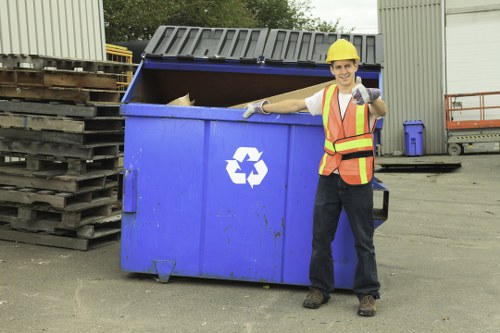 Training and competence are essential. All staff receive induction training that covers manual handling techniques, sharps awareness, hazardous waste recognition and safe vehicle operation. Ongoing training includes refresher courses, toolbox talks and recorded competency checks. We also provide role-specific instruction for drivers, plant operators and depot staff so the team remains informed about changes in legislation and best practice for commercial refuse removal and waste disposal.
PPE, equipment and vehicle safety are strictly mandated. High-visibility clothing, gloves suitable for the waste types handled, eye protection and footwear with toe protection are minimum requirements. Vehicles are maintained under a scheduled inspection regime, with pre-shift checks documented and defects reported immediately. Loading and unloading procedures are standardised and enforced to prevent overturning, falling objects or contact injuries while performing waste collection services across the service area.
 Operational controls focus on segregation, traceability and lawful disposal. Waste is classified at the point of collection and segregated into recyclables, general commercial waste, and hazardous streams. Records of waste movements are maintained to support duty of care obligations and to demonstrate that collected material is transferred to authorised facilities. These measures reduce environmental risk and help our rubbish company service area meet its regulatory responsibilities without unnecessary local detail in this legal policy statement.
Incident reporting and investigation procedures are in place to ensure lessons learned are fed back into practice. All accidents, near misses and dangerous occurrences must be reported immediately and investigated by a competent person. Findings result in corrective actions, revised risk assessments and, where necessary, retraining. Continuous improvement through audits and performance reviews is a priority; internal audits and third-party inspections are used to verify compliance with safety objectives.